Health and Safety Policy — House Clearance Wembley Operations
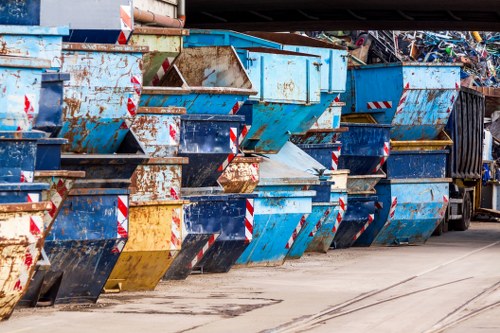 Purpose and commitment: This Health and Safety policy sets out the approach adopted by our rubbish removal and house clearance teams to protect staff, contractors, clients and the public. It applies to all House Clearance Wembley activities and related rubbish company service area operations. The organisation is committed to maintaining safe systems of work, preventing injury and ill health, and ensuring compliance with applicable health and safety law. This statement is the policy framework: specific safe working procedures are prepared for individual sites and tasks.
Scope and application
This policy covers all aspects of Wembley house clearance, including attic and basement clearing, furniture removal, hazardous materials identification, and transfer of waste to authorised disposal facilities. It also applies to subcontractors and temporary staff engaged to provide house clearance services in the wider rubbish collection service area. Responsibilities extend from office-based planning through to on-site execution, transport, and storage of items prior to disposal or recycling.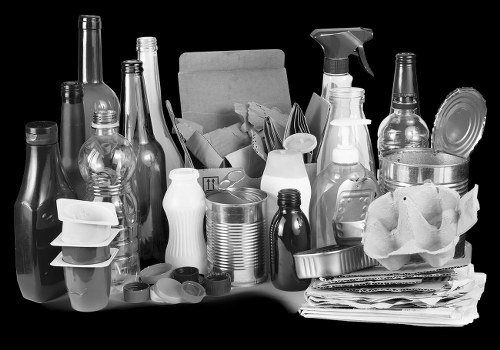 Responsibilities — The management team is responsible for providing leadership and resources to implement this policy. Supervisors must ensure that risk assessments are carried out and that safe work instructions are available. All employees and contractors must follow procedures, use provided PPE, report hazards or near-misses, and attend required training. A named health and safety coordinator will maintain records, oversee inspections, and lead incident investigations when necessary.
Risk assessment and safe systems
Risk assessments shall be undertaken for every clearance job to identify hazards such as manual handling risks, sharps and broken glass, asbestos-containing materials, chemical contamination, biohazards, extreme loads, and confined spaces. Control measures will follow a hierarchy: eliminate, substitute, engineer, administrate and provide PPE. Job-specific method statements will detail safe lifting techniques, two-person lifts for bulky items and mechanical aids for heavy items to reduce musculoskeletal injuries during house clearance services.Personal protective equipment and hygiene: Appropriate PPE must be provided and worn for rubbish removal and bulky waste handling: gloves, safety boots, high-visibility clothing, eye protection and respiratory protection when dust or biohazards are present. Hand-washing facilities and sanitiser shall be available at sites, and employees are required to maintain hygiene standards to reduce infection risks when handling contaminated materials.
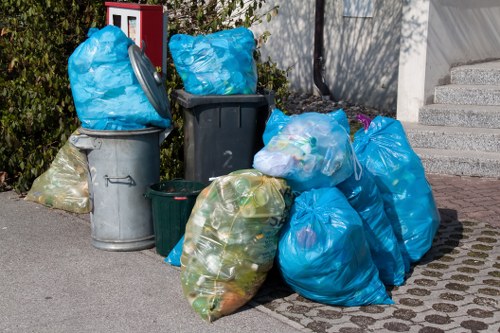 Waste handling, segregation and transport — Waste will be segregated at source wherever possible into recyclable, hazardous and general waste streams in accordance with regulatory expectations for a reputable rubbish company service area. Hazardous items discovered during house clearances (e.g., batteries, solvents, asbestos suspect materials, sharps) will be isolated and handled only by trained personnel following hazardous waste procedures. Vehicles used for removal will be secured, load limits observed and manifests completed for controlled wastes to ensure traceability.
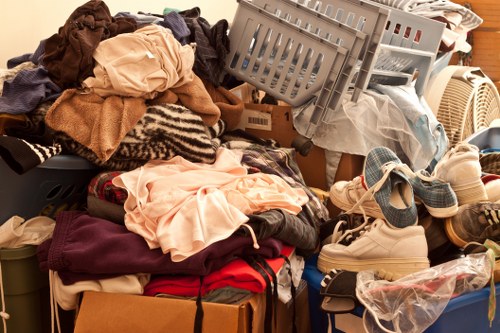 Vehicle, site and public safety — Safe vehicle operation is essential. Drivers and loaders will ensure vehicles are roadworthy, loads are properly restrained and manual handling protocols observed during loading and unloading. House clearance sites often interface with public footpaths and neighbours; therefore traffic management, appropriate signage and cordoning must be used to protect passersby. Noise and dust controls should be implemented to minimise disturbance within the service area.
Training, competence and supervision: All staff performing house clearance roles shall receive induction and regular refresher training in manual handling, hazardous waste awareness, PPE use, emergency procedures and vehicle safety. Competence will be assessed and documented. Supervisors will provide on-site oversight and ensure that inexperienced workers are not left unsupervised in potentially hazardous tasks. Training records and certification form part of the company’s compliance documentation.
 Incident reporting and emergency response — All incidents, injuries, near misses and environmental releases are to be reported without delay. An incident reporting procedure supports immediate first aid, site isolation if required, and escalation to emergency services. A documented emergency plan will define evacuation routes, assembly points, first-aid provisions and contact procedures for serious events. Lessons learned from investigations will be used to update risk assessments and procedures to prevent recurrence.
Monitoring, audit and continual improvement — We will monitor health and safety performance through regular site inspections, audits, toolbox talks and reviews of incident trends. Key performance indicators include incident frequency, completion of risk assessments, training currency and audit outcomes. Findings will be reported to senior management and used to allocate resources for improvements in equipment, training or operational controls within the house clearance and rubbish removal services.
Legal compliance and contractor management — The organisation will comply with applicable statutory duties and industry best practice across the rubbish collection service area. Contractors and subcontractors engaged to deliver parts of the house clearance service must demonstrate equivalent health and safety standards before appointment. Contract arrangements require evidence of insurance, method statements, risk assessments and approved permit-to-work arrangements where necessary.
Policy review — This policy will be reviewed at least annually or more frequently following significant incidents, operational changes, or changes in legal or regulatory requirements. Management remains accountable for ensuring that the policy objectives are met and that the provision of safe, reliable and compliant house clearance operations continues across the service area.